Six New Yorkers sue Trump over White House media access
The lawsuit filed in federal district court argues that banning critical outlets from the Oval Office violates the public's First Amendment rights to independent news.
By Cole Anderson ·
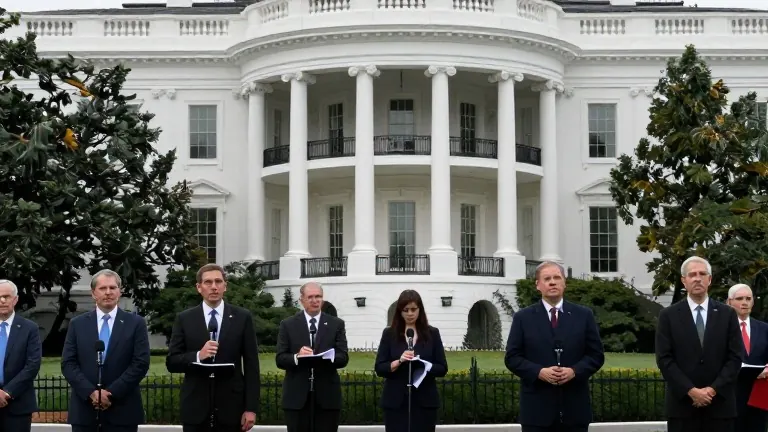
Six residents of New York state filed a federal lawsuit on Monday challenging President Donald Trump's policy of restricting media access to the White House. The plaintiffs argue that when the administration bars critical news outlets from covering the president, it harms the general public just as much as it harms the press. The suit asks a federal judge in New York to issue an injunction that would stop the White House from punishing reporters for their coverage.
The complaint names Trump alongside White House Chief of Staff Susie Wiles, Communications Director Steven Cheung, and Secret Service Director Sean M. Curran. The group argues that the current policy creates a limited public forum where access is denied based on viewpoint. They seek a declaration that this practice is unconstitutional because it imposes unreasonable restrictions on how Americans receive information about their government.
Katie Fallow, deputy litigation director at the Knight First Amendment Institute, which filed the suit with the Media Freedom & Information Access Clinic at Yale Law School, explained the stakes for the average citizen. "The First Amendment protects the public’s right to know what its government is doing," Fallow said. She noted that when the White House expels reporters for their coverage, the result is often closer to government propaganda than independent reporting.
The six plaintiffs represent a range of professions that depend on daily White House coverage. They include Kenneth Roth, a former executive director of Human Rights Watch; Beverly Gage, a Yale history professor; and Peter Schmidt-Nowara, a high school social studies teacher in Brooklyn. Others include journalists Daniel Froomkin and Benjamin Wittes, as well as Ethan Young, a student editor at the University of Pennsylvania. Each claims that the lack of independent reporting affects their work in teaching, writing, or advocating.
Schmidt-Nowara stated that he joined the lawsuit because his students deserve access to accurate information. "I want my students to have access to accurate, independent reporting about their government," he said in the complaint. Young, who relies on the press corps as a proxy for his own reporting, noted that the changes are acutely felt on college campuses.
The White House responded to the filing by stating that no person may demand access to the Oval Office. An unidentified official added that media outlets peddling misinformation are capable of reporting their stories from outside the building. The administration’s position contrasts with the view of the plaintiffs, who argue that the ban forces journalists to self-censor to keep their access.
This case follows several other legal battles currently underway involving major news organizations. CNN, MSNBC, and Politico are suing over a ban that took effect in September, while the Associated Press is fighting restrictions related to the name change of the Gulf of Mexico. A federal judge has already extended an order preventing the White House from enforcing the ban against those outlets while their cases proceed. The new lawsuit by the six citizens seeks to expand that protection to all news organizations, not just the ones currently in court.
Source: ABC News